Guide record · एक नज़र में
- Net sown area
- ~140 mn ha, flat since 1970s
- Agri share of land
- 66.7% (1951) → ~58.7% (2023)
- Lost to non-agri use
- 2+ mn ha in a decade
- Avg holding size
- 2.28 ha (1971) → 1.08 ha (2016)
- Holdings count
- ~71 mn → ~146.5 mn
- Direction
- Less land, more claimants
Some investment stories need imagination. This one only needs subtraction. India's land area is fixed at about 328.7 million hectares. Its cultivated core — the net sown area — climbed until the early 1970s, touched roughly 140 million hectares, and then stopped growing. Fifty years later it is still there, drifting slightly downward. On the other side of the equation, everything grows: population, cities, highways, factories, solar parks. This article lays out the numbers behind India's slowest-moving certainty — farmland scarcity — and what it does and does not mean for landowners.
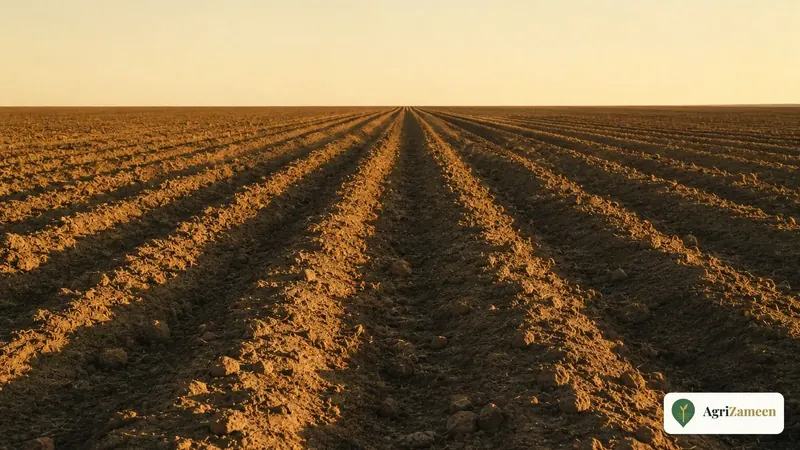
The supply side: a line that stopped rising आपूर्ति: जो रेखा 1970 में रुक गई
Agriculture's share of India's reported land area has fallen from about 66.7% in 1950-51 to roughly 58.7% by 2022-23. Recent official land-use statistics record continued small annual declines in net sown area, and analyses estimate over two million hectares shifted to non-agricultural uses in just the last decade. There is effectively no new land left to bring under the plough — future food growth must come from yield, not area.
The demand side: more claimants every year मांग: दावेदार हर साल ज़्यादा
- Cities eat edges. Research on Indian urbanisation finds farm-to-urban conversion happening intensively around smaller and mid-sized cities — the Jaipurs and Dausas, not only the metros — precisely where much family-held farmland sits.
- Infrastructure needs alignments. Expressways, freight corridors, airports and industrial zones acquire and re-rate agricultural belts along their paths.
- Energy needs acreage. Utility-scale solar and wind — a Rajasthan speciality — competes for the same open land.
- Food demand keeps rising with population and incomes, tightening the value of productive soil itself. (Full demand math in 1.4 Billion Plates, Fixed Land.)
The multiplier nobody prices in: fragmentation तीसरी ताक़त: बंटवारा
Agriculture Census data shows the average operational holding shrank from 2.28 hectares in 1970-71 to 1.08 hectares by 2015-16, while the number of holdings more than doubled to about 146.5 million. Every generation, the same fixed land divides among more heirs. The practical result: clean, consolidated, well-recorded parcels of meaningful size are becoming genuinely rare — and rarity is exactly what markets eventually price.
What scarcity means — and what it doesn't इसका मतलब क्या है, क्या नहीं
It means the long-term backdrop favours holders of well-located, well-documented agricultural land: a shrinking, fragmenting supply facing multi-directional demand. It does not mean every plot appreciates. Scarcity lifts the asset class's floor over decades; your plot's outcome still depends on access, water, records, zoning and local demand. A landlocked, disputed khasra participates in none of this story.
Owner's takeaway: in a scarcity era, the winning move is often simply not losing — updated records, protected boundaries, productive use, and patience. The trend does the rest, on its own timetable, with no guarantees.
Fragmentation makes every biswa count. Track exactly how much of a divided khasra is yours — in any unit — with the free AgriZameen Land Area Converter.
FAQ अक्सर पूछे जाने वाले सवाल
Is agricultural land really decreasing in India?
The total area under agriculture has been declining slowly — official land-use statistics show small year-on-year drops in net sown area and a long fall in agriculture's share of land, with estimates of more than two million hectares moving to non-agricultural uses over the past decade. The bigger shift is fragmentation: the same land divided among far more owners.
What is causing farmland loss?
Urban expansion, industrial and infrastructure projects, and mining convert land outright; inheritance-driven fragmentation, soil degradation and water stress reduce the usable value of what remains. Studies also find conversion pressure is strong around smaller, fast-growing cities — not just metros.
Does scarcity mean my land will definitely appreciate?
No. Scarcity is a macro tailwind, not a plot-level promise. Location, access, records, water and local demand decide individual outcomes; poorly located or disputed land can stagnate despite national trends.
What should existing landowners do about this trend?
Protect the asset: keep jamabandi and mutation updated, keep the land productive so possession records stay clean, guard boundaries, and stay informed about master-plan and corridor developments around your village.
Reviewed July 2026. Land law, stamp duty, DLC rates and departmental procedure change without notice — confirm the current position on the official state portal, and with a licensed advocate or CA, before you act. Nothing here is legal, tax or investment advice, and no return is assured.