- A working, legal water source changes a parcel more than any announced highway does.
- Groundwater in India is categorised by how much is being drawn against what recharges — safe, semi-critical, critical, over-exploited. The category shapes what new extraction is permitted.
- Assume nothing from the presence of a pipe. Ask whether the source exists on record, whether it works in summer, and whether the water is usable.
- Near Sambhar, the question is not only is there water but is the water usable.
Buyers spend weeks studying corridor maps and about ten minutes on water. It should be the other way round. A road changes how quickly you reach the land. Water changes what the land can do.
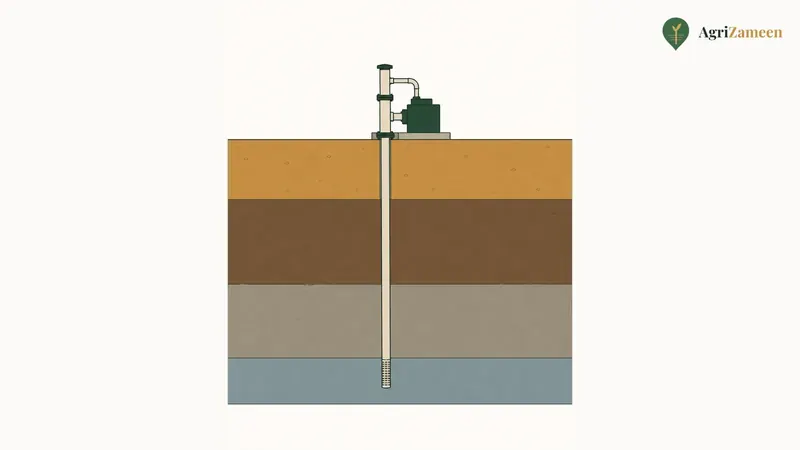
Why water decides more than the roadपानी क्यों बड़ा फ़ैसला है
Rain-fed land — barani in the record — produces what the monsoon allows. Irrigated land — chahi — produces what you plan for. That difference shows up in yield, in cropping choice, in how many seasons the land earns, and therefore in what the land is worth to anyone who intends to farm it.
It also shows up in resale. The next buyer will ask the same question you should be asking now.
Groundwater categories, plainlyभूजल श्रेणियाँ
India’s groundwater assessment classifies blocks by the balance between extraction and recharge. The commonly used categories:
| Category | Broad meaning | Practical implication |
|---|---|---|
| Safe | Extraction well within recharge | New extraction generally least constrained |
| Semi-critical | Extraction approaching recharge | Greater scrutiny of new sources |
| Critical | Extraction close to or at recharge | Tight restrictions likely |
| Over-exploited | Extraction beyond recharge | New extraction heavily restricted; existing sources under pressure |
Permission and who grants itअनुमति कौन देता है
Sinking a new borewell is not always a matter of calling a rig. Depending on the category of the assessment unit, the purpose of extraction and the applicable state rules, permission from the competent authority may be required. Requirements differ for domestic use, agricultural use and commercial or industrial extraction.
Three practical points. First, an existing legal source is worth more than a permission you might get — because you might not get it. Second, a rig operator’s confidence is not a permission; get the position from the department. Third, an unauthorised borewell is a liability that transfers to you along with the land.
Reading the water story of a parcelपानी की कहानी कैसे पढ़ें
The salinity problemखारेपन की समस्या
Around Sambhar Lake, and in salt-affected belts more generally, water can be present and still be unusable for most crops. Salinity in soil and groundwater limits what will grow, and it is not fixed by adding a bigger pump.
This is not a reason to avoid the belt. It is a reason to test rather than assume, and to match your plan to the parcel. Land that will not take wheat may do well with salt-tolerant crops, or may be better suited to a non-agricultural purpose entirely — subject to the rules on that. Our Sambhar buying guide covers the local specifics.
A water checklist for site visitsसाइट विज़िट चेकलिस्ट
Take these questions with you. Write the answers down on the spot, because you will not remember which parcel said what.
Is there an existing well or borewell, and is it recorded? What depth was it sunk to, and what depth is water standing at now? Does it run through summer, and has it ever failed? What is the groundwater category for this block? Has the water been tested, and can you see the report? What are neighbours doing for water, and at what depth? Is there any canal or scheme supply, present or promised, and is the promise documented? And finally — what would you do on this land if the borewell failed next year?
If the last question has no answer, you are buying on hope. Take the checklist further with our full due-diligence list.
FAQ · अक्सर पूछे सवाल
Do I need permission to dig a borewell on my agricultural land?
It depends on the groundwater category of the assessment unit, the purpose of extraction, and the state rules in force. In areas classified as critical or over-exploited, new extraction is heavily restricted. Confirm the current position with the competent local authority before you commit to a plan that depends on a new borewell.
How do I find out the groundwater category of an area?
Groundwater assessment categorises blocks or assessment units as safe, semi-critical, critical or over-exploited, and the categorisation is revised periodically. Ask at the local groundwater or agriculture department office for the current category rather than relying on older figures or on the seller.
Is barani land worth buying?
It can be, at the right price and for the right purpose. Rain-fed land produces what the monsoon allows, which limits cropping options and yield certainty. Much of Rajasthan is barani. The mistake is paying an irrigated-land price for rain-fed land.
Why does water near Sambhar Lake need extra checking?
Salt-affected belts can have water present that is not usable for most crops. Salinity in soil and groundwater limits what will grow and cannot be solved with a bigger pump. Test soil and water before planning any cultivation there.